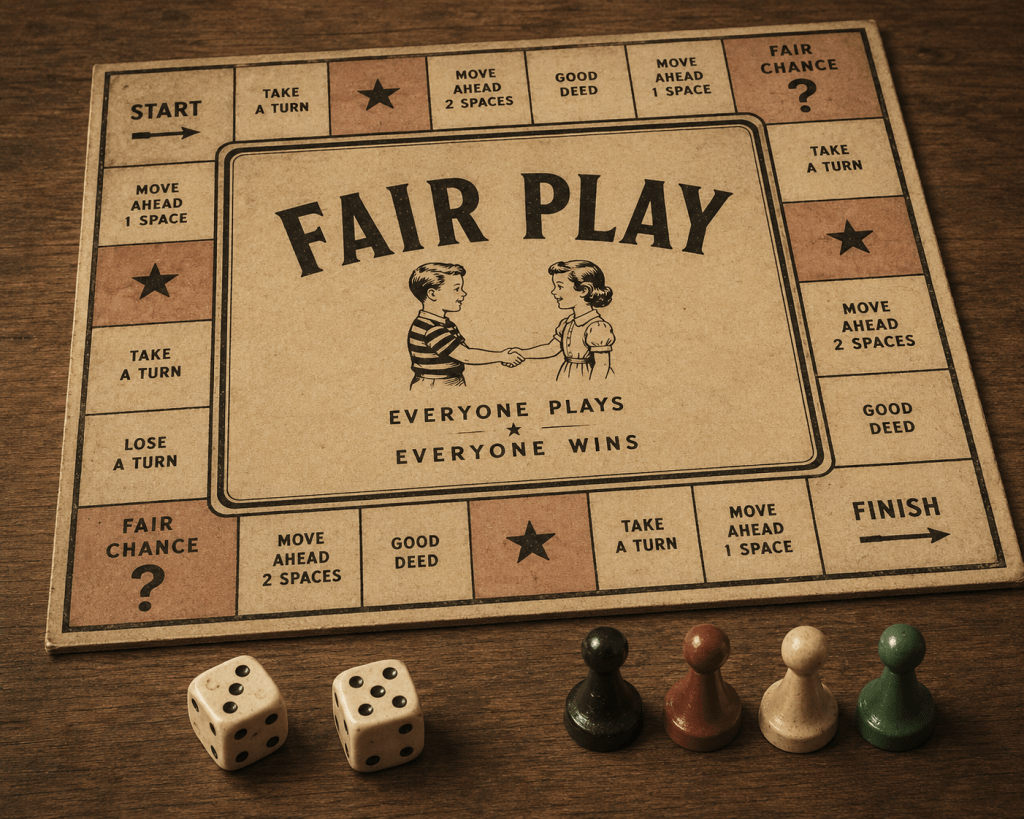
June 18, 2026 — So much of what I do as an attorney is about “fair play.” The idea that we should play fair with each other is described by C.S. Lewis in his book Mere Christianity as one of the proofs of the existence of God. Referring to statements like “How’d you like it if anyone did the same to you?” and “Come on, you promised,” Lewis states, “Now what interests me about all these remarks is that the man who makes them is not merely saying that the other man’s behaviour does not happen to please him. He is appealing to some kind of standard of behaviour which he expects the other man to know about…. It looks, in fact, very much as if both parties had in mind some kind of Law or Rule of fair play or decent behaviour or morality or whatever you like to call it, about which they really agreed.” From this concept, Lewis is able to make a reasoned argument for the reality of the divine.
Growing up with several siblings, the concept of “fair play” was a major theme in my formative years. Today in my profession, I am constantly appealing to the concept of “fair play.” The idea of “fair play” is the basis for the Common Law and for the principle of “Due Process.” If you try to explain “Due Process” to someone unfamiliar with the concept of being fair, you might as well be talking to a wall. Due Process is the legal norm of what is required in our system to be considered playing fair with our neighbors.
One of the key issues in the law is whether the concept of Due Process morphs over time. Is what was considered “fair” in the past the same as what we presently consider “fair”? I think there are some universal norms that everyone can agree on. But our Courts have also seen the risks with having a definition of Due Process which moves from procedural norms into the substantive areas of life. Is it fair to change the rules when the rules can be made up by judges who are on the bench at that moment in history?
Recently, I heard a prominent jurist speak at a dinner about his view that he chose pragmatism in making his decisions rather than feeling bound to the text of the Constitution. Is that fair? If we have a written Constitution which sets out delineations on what is the law, and the ability to change the law under another set of rules if the law isn’t working, is it fair that one person should be able to say, “I’m going to use my own judgment and not follow that rule”? I understand that we need jurists to call the balls and strikes, but there is a written standard that the balls and strikes are based on.
 Ted Kittila, Attorney at Law