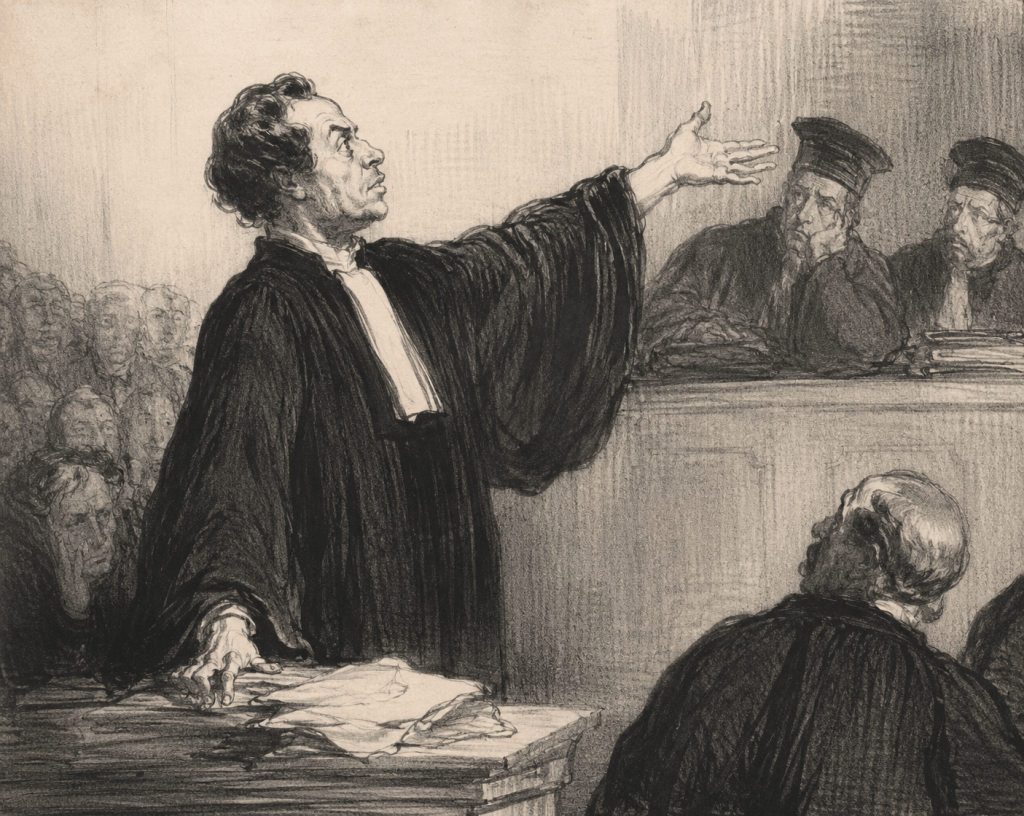
June 16, 2026 — Preparing for oral argument is like preparing for a final exam. It takes roughly the same set of skills that I learned as a student (reviewing, re-reviewing, memorizing, cramming, worrying, re-re-reviewing), but with a new spin: at least I’m getting paid for doing this. I have an oral argument next week that is going to require a lot of my attention — literally days of reviewing and re-reviewing cases, pleadings, etc., all with the goal of putting on a short presentation to a person in a black robe.
Just like a final exam, I am going to be expected to answer questions. Some of these questions will be things that I expect: dates, times, locations (in code sections), but there’s always the chance that there is going to be something that I didn’t fully consider. “Are you aware of a holding from this 1871 Supreme Court case on … ?” That’s the stuff of nightmares for me.
The big difference between oral argument and a final exam is that in oral argument, you have someone that is trying to attack your responses to the questions. It’s like a final exam where the exam actually turns on you and tells you that you are wrong. Most of the time, this comes from your adversary (or as we call them in Delaware, “Our Friend” — yes, we use this term for opposing counsel). “Our Friend” — if he or she is on their game — will be listening to my every word, waiting to spring the moment that I open a weak area for attack. When the Court asks a question that may expose a weakness in my argument, the other side will be sure to remind the Court of that weakness when it’s their turn at the podium. With Friends like these …
Preparing for the argument is an exercise in trying to find time. I like to read every case cited, and then try to read every case that is cited in those cases. This becomes a struggle when you have the phone ringing with clients or colleagues asking for “just five minutes.” Reading the pleadings cover to cover is always an absolute necessity. How many times have I gone back and read things that I wrote, sometimes months earlier, and said, “Wait, that was a good idea. Why didn’t I make more of that?” Of course, re-reading your briefs is an exercise in humility: each typo makes me wince. “How did I miss that?” (More on typos in a later post.)
I write my arguments, sometimes in long hand, sometimes typed, word for word. This is a terrible habit. But I always justify it as “just in case I get hit by a bus on the way into the Courtroom.” The truth is that I still get nervous public speaking and sometimes having that security blanket to get me through my first 15 seconds of argument is enough to carry me through the next 20 minutes. By about the point that I finish, “May it please the Court …,” those notes are gone. Still, having those notes gives me some confidence that I will hit all of my points, even if the judge wants to go a completely different direction. That’s their prerogative as a judge — it’s their courtroom, the argument is for them, so they get to call the shots on the direction. Heck, they’re the ones grading the exam.
I don’t think I’ve revealed anything that wouldn’t otherwise be known by a skilled lawyer about my strategy. In other words, I don’t see someone reading this, and like George C. Scott in Patton, yelling, “Rommel, you magnificent bastard! I read your book!” (I have always loved Scott’s portrayal of Patton — another post, another time.) Again, until I hear someone quote back to me that they read my blog, I won’t worry about it. I have got so much more to worry about in preparing for argument next week.
 Ted Kittila, Attorney at Law